FIELD BRIEFING · EDITION 005 · 21 AUGUST 2026
Direct awards accelerate cloud procurement when planning controls operational risk
The operating question inside “Direct awards accelerate cloud procurement when planning controls operational risk” is traced from a current record through market evidence, research, counterevidence and a public model.
Where does evidence end—and management judgement begin—around “Direct awards accelerate cloud procurement when planning controls operational risk”?
- Sources
- 6
- Evidence families
- 5
- Material claims
- 12
- State
- Permanent
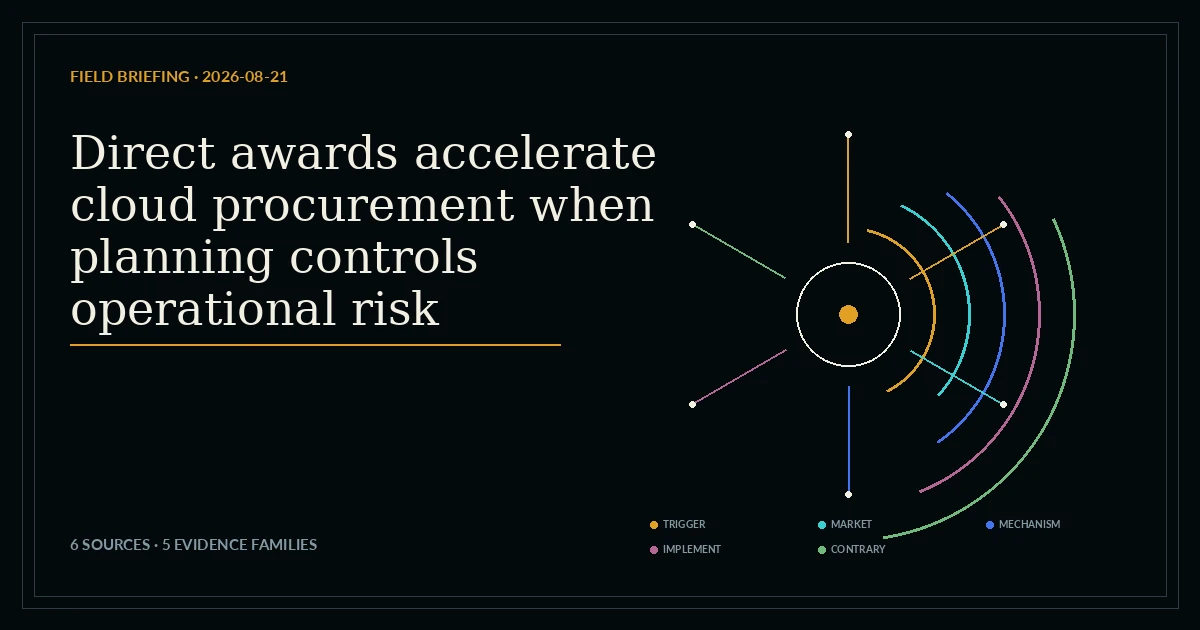
READ THIS FIELD IN 30 SECONDS
Four reading moves. Five evidence roles.
This is not a summary of several articles. It is a worked decision: a current record opens the question, different evidence tests it, and the limits stay visible.
What happened?
Public regulatory bodies utilise framework agreements to secure technology delivery assurance and risk review services via selective direct-award structures.
What must be decided?
Where does evidence end—and management judgement begin—around “Direct awards accelerate cloud procurement when planning controls operational risk”?
What follows responsibly?
For “Direct awards accelerate cloud procurement when planning controls operational risk”, the evidence identifies conditions to test before commitment—not a promised result.
What is not proved?
The organisation-specific operating baseline is not established.
01 · THE EVENT · WHAT THE RECORD ESTABLISHES
Strategic Support Contract for Technology Delivery Assurance and Operational Risk Review
Public regulatory bodies utilise framework agreements to secure technology delivery assurance and risk review services via selective direct-award structures.
The contract was direct awarded under G-Cloud 14 Framework Agreement RM1557.14, Lot 3: Cloud Support.
02 · WHY ONE RECORD IS NOT ENOUGH
Five roles. No evidence blender.
Each source contributes something different. The labels below say both what it adds and what it cannot establish, so context is never mistaken for proof.
What happened?
Public regulatory bodies utilise framework agreements to secure technology delivery assurance and risk review services via selective direct-award structures. Public sector organisations access cloud-based computing and support services through a centralised national digital catalogue governed by standard commercial regulations.
The record establishes an event, not its eventual outcome.What is happening more widely?
The release from Office for National Statistics supplies dated external context for the decision.
The wider field cannot prove the local result.How might it happen?
Successful technology adoption relies on securing adequate preparatory time for system selection alongside structured organizational readiness activities.
A mechanism may not transfer into this setting.What must practice establish?
Service evaluation requires combining performance analytics with direct stakeholder feedback to validate technology implementation outcomes.
Guidance becomes evidence only when applied and measured.What could make the reading wrong?
Adoption of cutting-edge technologies faces heightened external regulation barriers and skills shortages compared to established digital tools.
Counterevidence tests the claim; it does not decide it alone.Observed boundary: The retrieved records establish context and plausible mechanisms; they do not establish a company-specific causal outcome.
03 · THE DECISION CHAIN
Follow the claim from record to action.
Each passage below has one job. Read the headings first; open the technical ledger later only if you need to inspect the route in full.
Direct Awards Streamline Technology Procurement
Public regulatory bodies utilise framework agreements to secure technology delivery assurance and risk review services via selective direct-award structures.
Public sector organisations access cloud-based computing and support services through a centralised national digital catalogue governed by standard commercial regulations.
Claim route · claim_current_trigger · claim_historical_frameworkPlanning Controls Technological Adoption
Successful technology adoption relies on securing adequate preparatory time for system selection alongside structured organizational readiness activities.
Claim route · claim_mechanism_planningEnvironmental Obstacles to Advanced Systems
Adoption of cutting-edge technologies faces heightened external regulation barriers and skills shortages compared to established digital tools.
Claim route · claim_contrary_barriersStructured Metrics Validate Implementation Success
Service evaluation requires combining performance analytics with direct stakeholder feedback to validate technology implementation outcomes.
For “Direct awards accelerate cloud procurement when planning controls operational risk”, the evidence identifies conditions to test before commitment—not a promised result.
Claim route · claim_org_context_metrics · claim_conclusion_interpretationWhat the model can test
The retrieved records establish context; they do not establish the scenario result.
The sandbox changes disclosed operating inputs and recomputes comparative indices through a fixed public formula.
Those movements are conditional illustrations, not measured company outcomes, causal findings or forecasts.
Claim route · claim_model_capacity · claim_model_cash · claim_model_quality · claim_model_resilience · claim_model_contributionWhat the wider field shows
The release from Office for National Statistics supplies dated external context for the decision.
Claim route · claim-official-market-data04 · OPTIONAL ASSUMPTION LAB · MODELLED SCENARIO
Test the conditions—not the conclusion.
This instrument is deliberately separate from the evidence above. It lets you disturb one disclosed assumption and observe the formula’s response; it does not score the purchase, predict productivity or report an organisation’s result.
Open the optional scenario controls
A relative scenario index; it is not measured output or a forecast.
A comparative scenario index before tax and finance; it is not profit.
A directional scenario index; it is not a cash-flow forecast.
A directional scenario index; it is not an assurance assessment.
A comparative scenario index; it is not organisational resilience certification.
Change one condition. The trace will name what moved and what remained an assumption.
Read the model, sensitivity and boundary
Formulae · growth-capacity-v1
- productive_capacity = 100 × (1 + capacity_gain/100) × clamp(1 − adoption_drag/100, 0.2, 1.2) × clamp(1 − rework_rate/100, 0.2, 1.1)
- contribution_index = 100 × (1 + demand_change/100) × (1 + price_change/100) × productive_capacity/100 − fixed_investment × 0.35
- quality_exposure = clamp(rework_rate + adoption_drag × 0.45 − retention_change × 0.20, 0, 100)
- cash_pressure = clamp((working_capital_days/45) × (1 + demand_change/100) × 38 + fixed_investment × 0.24, 0, 160)
- resilience_index = clamp(100 − cash_pressure × 0.28 − quality_exposure × 0.52 + retention_change × 0.45, 0, 120)
Assumptions
- Every input is a disclosed scenario value selected for exploration, not an observed baseline.
- The formula expresses chosen directional relationships; it does not estimate causality.
- The output indices compare states inside this model and do not forecast an organisation's result.
Sensitivity
Move one disclosed input at a time to see which assumption changes the comparison first.
Switching value: Use the controls to locate the point at which the preferred direction changes; the interface reports a scenario boundary, not an observed threshold.
Alternative explanation
A different result may reflect input timing, scope or omitted conditions rather than the relationship tested here.
Model boundary: An educational comparison of disclosed operating conditions; it is not an observed baseline, causal estimate or forecast. · Horizon: one planning cycle
05 · APPLY IT TO YOUR DECISION
Turn the reading into a controlled test.
Separate what happened from what may explain it. Name the local baseline, owner, measure and review point before applying the interpretation to your own decision.
- 01
Name the decision and its boundary.
Owner Named decision owner
Evidence Retained source packet
Measure Decision and boundary recorded
Review · Qualification review - 02
Test the operating condition against retained evidence.
Owner Named operating owner
Evidence Disclosed scenario and evidence register
Measure Switching condition recorded
Review · Controlled operating review - 03
Record the outcome and return the learning.
Owner Named evidence owner
Evidence Outcome and learning record
Measure Learning returned to the next decision
Review · Learning review
06 · WHAT THE FIELD CANNOT YET KNOW
Uncertainty remains part of the instrument.
- The organisation-specific operating baseline is not established.
- Transfer of the cited mechanism to this organisation is not tested here.
For “Direct awards accelerate cloud procurement when planning controls operational risk”, the evidence identifies conditions to test before commitment—not a promised result.
07 · SCIENTIFIC READING
The prose opens. The machinery remains inspectable.
Every material statement below retains its state and evidence route. Classification describes what the statement is—not how impressive it sounds.
Claim ledger · 12 material statements
Public regulatory bodies utilise framework agreements to secure technology delivery assurance and risk review services via selective direct-award structures.
The qualitative analysis is limited to UK public sector cloud support frameworks.Public sector organisations access cloud-based computing and support services through a centralised national digital catalogue governed by standard commercial regulations.
The framework parameters are bounded by national commercial procurement regulations.Successful technology adoption relies on securing adequate preparatory time for system selection alongside structured organizational readiness activities.
The mechanism review covers international evidence for electronic system adoption in healthcare.Adoption of cutting-edge technologies faces heightened external regulation barriers and skills shortages compared to established digital tools.
The contrary evidence is drawn from rapid reviews of UK business technology adoption.Service evaluation requires combining performance analytics with direct stakeholder feedback to validate technology implementation outcomes.
The organisational context covers central government digital service standards.For “Direct awards accelerate cloud procurement when planning controls operational risk”, the evidence identifies conditions to test before commitment—not a promised result.
The synthesis remains conditional on the cited scope, period and organisation-specific operating context.In the disclosed scenario, productive capacity moves as capacity gain, adoption drag and rework change.
A relative scenario index; it is not measured output or a forecast.In the disclosed scenario, cash pressure moves with working-capital days, demand and fixed investment.
A directional scenario index; it is not a cash-flow forecast.In the disclosed scenario, quality exposure moves with rework, adoption drag and retention.
A directional scenario index; it is not an assurance assessment.In the disclosed scenario, the resilience index moves with cash pressure, quality exposure and retention.
A comparative scenario index; it is not organisational resilience certification.In the disclosed scenario, the contribution index moves with demand, price, productive capacity and fixed investment.
A comparative scenario index before tax and finance; it is not profit.The release from Office for National Statistics supplies dated external context for the decision.
The cited source's stated scope, date and geography remain controlling.Measures and formulae · 5 measures · 5 calculations
Productive capacity
productive_capacity = 100 × (1 + capacity_gain/100) × clamp(1 − adoption_drag/100, 0.2, 1.2) × clamp(1 − rework_rate/100, 0.2, 1.1) Inputs · capacity_gain · adoption_drag · rework_rate
A relative scenario index; it is not measured output or a forecast.Contribution
contribution_index = 100 × (1 + demand_change/100) × (1 + price_change/100) × productive_capacity/100 − fixed_investment × 0.35 Inputs · demand_change · price_change · productive_capacity · fixed_investment
A comparative scenario index before tax and finance; it is not profit.Cash pressure
cash_pressure = clamp((working_capital_days/45) × (1 + demand_change/100) × 38 + fixed_investment × 0.24, 0, 160) Inputs · working_capital_days · demand_change · fixed_investment
A directional scenario index; it is not a cash-flow forecast.Quality exposure
quality_exposure = clamp(rework_rate + adoption_drag × 0.45 − retention_change × 0.20, 0, 100) Inputs · rework_rate · adoption_drag · retention_change
A directional scenario index; it is not an assurance assessment.Resilience
resilience_index = clamp(100 − cash_pressure × 0.28 − quality_exposure × 0.52 + retention_change × 0.45, 0, 120) Inputs · cash_pressure · quality_exposure · retention_change
A comparative scenario index; it is not organisational resilience certification.Complete source register · 6
Strategic Support Contract for Technology Delivery Assurance and Operational Risk Review
The contract was direct awarded under G-Cloud 14 Framework Agreement RM1557.14, Lot 3: Cloud Support.
- Publisher
- Contracts Finder OCDS
- Published
- 2026-08-17T12:42:26+00:00
- Retrieved
- 2026-08-17T16:00:27.087854+00:00
- Reference period
- Publication-specific
- Geography
- United Kingdom
- Record
- e7c2d65e6d12…
- Date basis
- retained record
- Access
- verified
G-Cloud 14 - GCA
G-Cloud 14 - GCA beta Help us make this service better for you.
- Publisher
- GCA
- First verified here
- 2026-08-21T09:17:27.052009+01:00
- Retrieved
- 2026-08-21T09:17:27.052009+01:00
- Reference period
- Publication-specific
- Geography
- United Kingdom
- Record
- 55a913188788…
- Date basis
- retrieval date
- Access
- verified
Business insights and impact on the UK economy - Office for National Statistics
[…] If trading businesses is not specifically specified, the statistics presented refer to businesses that have "Not permanently stopped trading".
- Publisher
- Office for National Statistics
- Published
- 2026-08-19
- Retrieved
- 2026-08-21T09:17:27.052009+01:00
- Reference period
- Publication-specific
- Geography
- United Kingdom
- Record
- 4749c6f1a8ef…
- Date basis
- source page
- Access
- verified
Factors that influence the implementation of e-health: a systematic review of systematic reviews (an update) - PMC
[…] The attitudes of colleagues [ ] and patients [ ] were also reported to influence staff attitudes with regard to e-health acceptance as…
- Publisher
- PubMed Central
- First verified here
- 2026-08-21T09:17:27.052009+01:00
- Retrieved
- 2026-08-21T09:17:27.052009+01:00
- Reference period
- Publication-specific
- Geography
- International evidence base; healthcare implementation context
- Record
- 3adc9f603a1c…
- Date basis
- retrieval date
- Access
- verified
Factors influencing firms’ adoption of advanced technologies: A rapid evidence review - GOV.UK
[…] The 11 main factors we identify, each consisting of a series of enablers and barriers, are: It is interesting to note that many…
- Publisher
- Department for Science, Innovation and Technology
- Published
- 2025-06-02
- Retrieved
- 2026-08-21T09:17:27.052009+01:00
- Reference period
- Publication-specific
- Geography
- United Kingdom evidence context
- Record
- 90f55150fb96…
- Date basis
- source page
- Access
- verified
How to set performance metrics for your service - Service Manual - GOV.UK
[…] Data sources could include: digital (web) analytics user feedback site performance call centre data financial information (for example, how much your hosting costs)…
- Publisher
- Government Digital Service
- Published
- 2017-12-05
- Retrieved
- 2026-08-21T09:17:27.052009+01:00
- Reference period
- Publication-specific
- Geography
- United Kingdom central government service context
- Record
- 6ea174cc0f14…
- Date basis
- source page
- Access
- verified
Reproducibility and corrections
- Edition
- FS-20260821-0005
- Source window
- 14 days
- Source packet
- 1b9a76184afdcc191e50c592cbbb0355e1ca5f01167e77cc47f2c7805f543ae2
- Retrieval state
- current primary trigger plus cited external research lanes
- Revision
- Original permanent state
Download the public study record ↗ Read the complete method →